Asymmetrical Eyelids
One eyelid may appear:
- Higher than the other
- Lower than the other
- More defined
- Less visible
Revision surgery can improve eyelid balance and symmetry.
1mm Plastic Surgery · Gangnam, Seoul
Revision double eyelid surgery is a specialized corrective procedure designed for patients who are dissatisfied with the results of previous eyelid surgery.

In short
Revision double eyelid surgery is a specialized corrective procedure designed for patients who are dissatisfied with the results of previous eyelid surgery. At 1mm Plastic Surgery in Gangnam, Seoul, Korea, revision eyelid surgery is customized to address concerns such as asymmetry, multiple creases, loose folds, overly high or low eyelid lines, unnatural appearance, persistent puffiness, and recurrence of monolids. Revision surgery is often more complex than primary double eyelid surgery because it requires careful analysis of existing scar tissue, eyelid anatomy, and previous surgical changes to achieve natural and balanced results.
Medically reviewed by Dr. Eon Rok Do, board-certified plastic surgeon · Updated October 2026
Overview
Revision double eyelid surgery is performed to improve or correct the results of previous eyelid surgery.
Common goals include:
Every revision procedure is individualized according to the patient's current anatomy and desired outcome.
Why 1mm
One eyelid may appear:
Revision surgery can improve eyelid balance and symmetry.
Over time, a previously created fold may weaken or disappear.
This may occur because of:
Some patients develop:
Revision surgery can help simplify and refine the crease.
High creases may create:
Low creases may:
Residual fat or tissue may create:
Revision surgery may address remaining tissue volume.
Candidates
Patients may be suitable candidates if they have:
Most surgeons recommend waiting until the previous surgery has adequately healed before undergoing revision.
04
Correction may involve:
Revision may help:
Excessive scar tissue may create:
Scar release techniques may be incorporated when necessary.
Some patients develop:
Treatment options may include tissue repositioning or volume restoration.
A crease that disappears after previous surgery may require stronger fixation techniques during revision.
05
Revision surgery is generally more complex because:
For this reason, revision surgery often requires advanced surgical planning and expertise.
Procedure
The exact technique depends on the problem being corrected.
Possible components include:
Each surgical plan is customized to the patient's needs.
Real result
A incisional double eyelid result at 1mm Plastic Surgery, Gangnam. Every case is planned around the patient's own anatomy.
Published with patient consent. Individual results vary with anatomy, healing and the technique used.
All before & after photos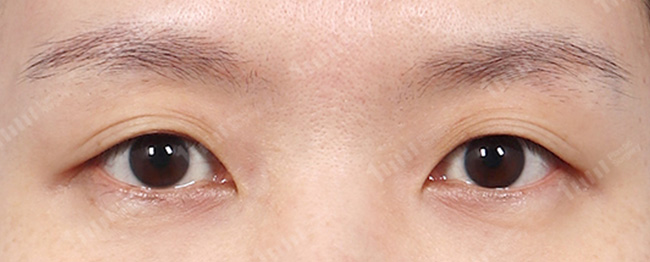
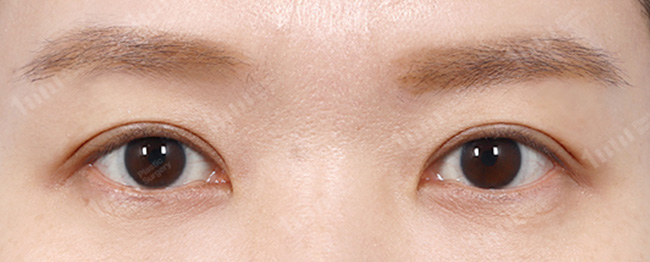
07
Yes.
Some patients discover that the underlying issue is not the crease itself but weakened eyelid-opening muscles.
Ptosis correction may improve:
A detailed consultation helps determine whether ptosis correction is appropriate.
Recovery
Revision surgery may require a longer recovery period than primary surgery.
Safety
Revision surgery often utilizes existing incision lines whenever possible.
Benefits include:
Careful surgical planning helps optimize cosmetic outcomes.
Why 1mm
Revision eyelid surgery requires advanced expertise and individualized planning.
Patients choose 1mm Plastic Surgery because of:
Questions
Still unsure? Message us on WhatsApp and a coordinator will reply in English.
Revision double eyelid surgery is a corrective procedure designed to improve the results of previous eyelid surgery.
Patients often consider revision surgery when they experience asymmetry, multiple folds, loose creases, high creases, low creases, or unsatisfactory cosmetic outcomes.
The appropriate timing depends on healing progress, but revision surgery is generally performed after adequate healing from the previous procedure.
Yes. Revision surgery is commonly performed to improve eyelid symmetry and balance.
Yes. Revision surgery can often restore or strengthen a weakened eyelid fold.
Yes. Revision procedures are generally more complex because scar tissue and previous surgical changes must be addressed.
In many cases, excessively high creases can be adjusted to create a more natural appearance.
Yes. Revision surgery can simplify multiple crease patterns and improve crease definition.
Revision procedures often utilize existing incision lines to minimize additional visible scarring.
Yes. Many international patients travel to Gangnam, Seoul, Korea specifically for specialized revision eyelid surgery.

Reviewed by
Representative Director of 1mm Plastic Surgery and board-certified plastic surgeon. Every operation at 1mm is performed by the surgeon named in your consultation and surgery record — no ghost or proxy surgery. Full surgeon profiles · English-speaking eyelid surgeon in Seoul
Start with a photo
Send a front-facing photo of your eyes, open and closed. A coordinator will reply with your surgeon's first opinion and help you plan your visit to Seoul.
Keep reading
Let’s Chat Today!
📞+82-10-9451-1171 (WhatsApp & Text)
English-Speaking & Foreigner-Friendly. We’re Here for You!
Let our board-certified specialists at Very Good Plastic Surgery Clinic help you achieve natural, balanced, and refreshed eyes.





📍 Location
449 Gangnam-daero, Seocho-gu, Seoul
Youngshin Building, 7F · 8F · 9F · 10F
📞 Phone Consultation / Reservation
T. +82-10-9451-1171