No Full Incision
Unlike incisional techniques, there is no long eyelid incision.
Benefits include:
- Minimal scarring
- Faster healing
- Reduced downtime
1mm Plastic Surgery · Gangnam, Seoul
Non-incisional ptosis correction is a minimally invasive eyelid procedure designed to improve drooping eyelids and weak eye opening without creating a full surgical incision.

In short
Non-incisional ptosis correction is a minimally invasive eyelid procedure designed to improve drooping eyelids and weak eye opening without creating a full surgical incision. Using specialized suture fixation techniques, the eyelid-opening muscles can be strengthened and repositioned through tiny entry points hidden within the eyelid. At 1mm Plastic Surgery in Gangnam, Seoul, Korea, non-incisional ptosis correction is customized according to eyelid anatomy, muscle strength, skin condition, and aesthetic goals to create brighter, more alert-looking eyes while minimizing recovery time and visible scarring.
Medically reviewed by Dr. Eon Rok Do, board-certified plastic surgeon · Updated October 2026
Overview
Non-incisional ptosis correction improves eyelid elevation without making a full incision across the eyelid.
The procedure typically involves:
The goal is to improve eye opening while maintaining a natural appearance.
Overview
Ptosis refers to drooping of the upper eyelid caused by weakness or stretching of the eyelid-opening structures.
Common symptoms include:
Many patients mistake ptosis for simply having small eyes when the underlying issue is reduced eyelid-opening strength.
Results
Unlike incisional techniques, there is no long eyelid incision.
Benefits include:
Most patients experience:
The procedure focuses on:
Because less tissue is manipulated, recovery may be more comfortable for selected patients.
Candidates
Non-incisional ptosis correction may be suitable for patients with:
A consultation is necessary to determine whether non-incisional or incisional correction is more appropriate.
Candidates
Some patients may benefit more from incisional surgery if they have:
In these situations, direct visualization of the eyelid structures may provide more predictable correction.
Procedure
The procedure typically includes:
The exact technique is individualized according to the patient's anatomy and degree of ptosis.
07
Many patients choose to combine:
Benefits include:
Both concerns can often be addressed during the same procedure.
Real result
A ptosis correction result at 1mm Plastic Surgery, Gangnam. Every case is planned around the patient's own anatomy.
Published with patient consent. Individual results vary with anatomy, healing and the technique used.
All before & after photos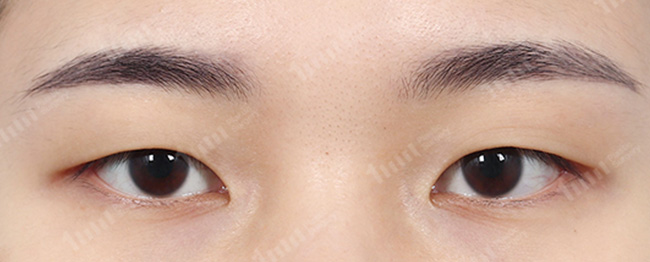
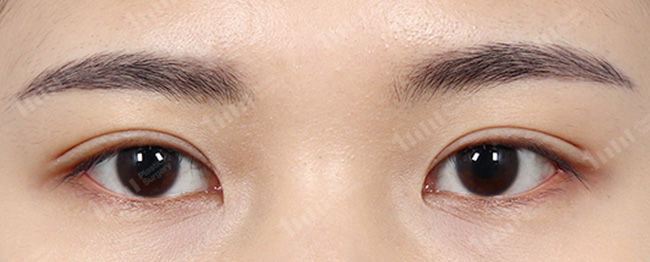
08
Patients frequently notice:
Improved eyelid elevation allows more of the eye to be visible.
The eyes often appear:
Correction can help balance differences in eyelid height and eye opening.
Many patients report improved crease visibility and overall eye contour.
Recovery
Recovery is generally faster than traditional incisional techniques.
Safety
One of the major advantages of non-incisional ptosis correction is the absence of a full incision line.
Benefits include:
Most puncture sites become difficult to identify after healing.
11
In some cases, adjustments or revision procedures may be possible if necessary.
However, careful surgical planning is important to maximize long-term satisfaction and stability.
Why 1mm
Patients choose 1mm Plastic Surgery because of:
Questions
Still unsure? Message us on WhatsApp and a coordinator will reply in English.
Non-incisional ptosis correction is a minimally invasive procedure that improves eyelid elevation using internal suture techniques without a full eyelid incision.
Patients with mild ptosis, thin eyelids, minimal excess skin, and good skin elasticity are often ideal candidates.
Results can be long-lasting, although durability depends on anatomy, tissue characteristics, and the degree of correction required.
Non-incisional correction uses internal sutures through tiny openings, while incisional correction uses a full eyelid crease incision for direct access to the eyelid muscles.
Yes. Many patients combine non-incisional ptosis correction with non-incisional double eyelid surgery.
Yes. Improving eyelid opening often makes the eyes appear larger, brighter, and more alert.
Most swelling improves significantly within one to two weeks, with continued refinement over the following months.
Visible scarring is minimal because the procedure is performed through tiny puncture sites rather than a full incision.
Yes. Non-incisional ptosis correction may improve eyelid height asymmetry and overall eye balance.
Yes. Many international patients travel to Gangnam, Seoul, Korea specifically for minimally invasive eyelid procedures.

Reviewed by
Representative Director of 1mm Plastic Surgery and board-certified plastic surgeon. Every operation at 1mm is performed by the surgeon named in your consultation and surgery record — no ghost or proxy surgery. Full surgeon profiles · English-speaking eyelid surgeon in Seoul
Start with a photo
Send a front-facing photo of your eyes, open and closed. A coordinator will reply with your surgeon's first opinion and help you plan your visit to Seoul.
Keep reading
Let’s Chat Today!
📞+82-10-9451-1171 (WhatsApp & Text)
English-Speaking & Foreigner-Friendly. We’re Here for You!
Let our board-certified specialists at Very Good Plastic Surgery Clinic help you achieve natural, balanced, and refreshed eyes.





📍 Location
449 Gangnam-daero, Seocho-gu, Seoul
Youngshin Building, 7F · 8F · 9F · 10F
📞 Phone Consultation / Reservation
T. +82-10-9451-1171